
NewsDetails
Can Electric Tricycles Use Mismatched Voltage Batteries?A Deep Dive into Technical Logic and Commercial Costs
author:Tricera Moto time:2026-09-11 10:42:23 Click:108
[Industry Insight] Can Electric Tricycles Use Mismatched Voltage Batteries? A Deep Dive into Technical Logic and Commercial Costs
Working on the frontlines of international trade and commercial vehicle exports, I frequently hear this question from distributors and fleet managers across overseas markets: "To increase speed, or to cope with local spare part shortages, can we replace the battery in our cargo electric tricycles with one of a higher or lower voltage?"
From a professional electrical engineering and system stability perspective, the answer is absolute: Absolutely not.
Let’s break down the underlying engineering logic and real-world data to understand exactly why "voltage mismatch" brings catastrophic consequences to the core electrical system (battery, motor, and controller).
1. The "Hard Destruction" of Overvoltage
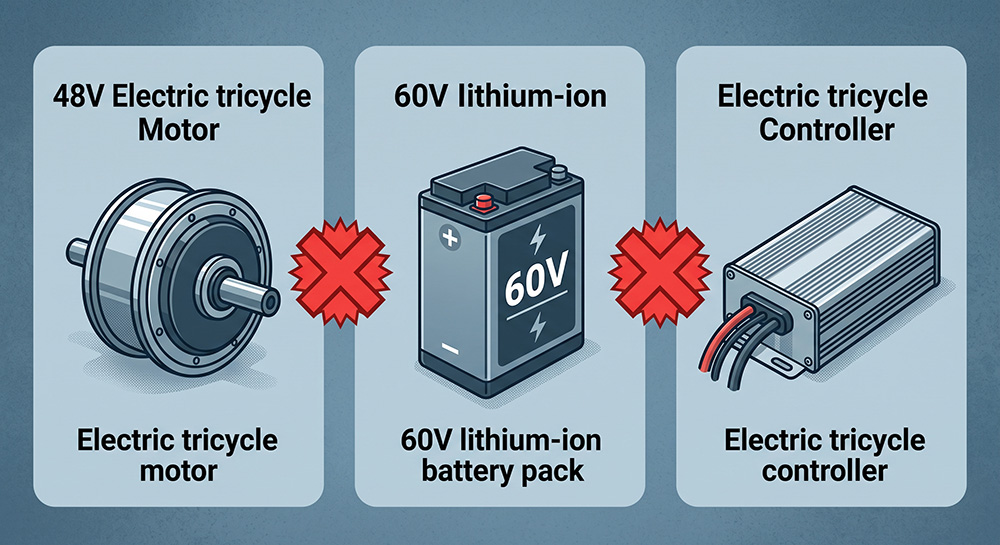
Some users mistakenly believe that forcing a higher voltage (e.g., using a 60V or 72V battery in a 48V system) will significantly boost the power and top speed of a cargo tricycle. In reality, this triggers fatal hardware overload:
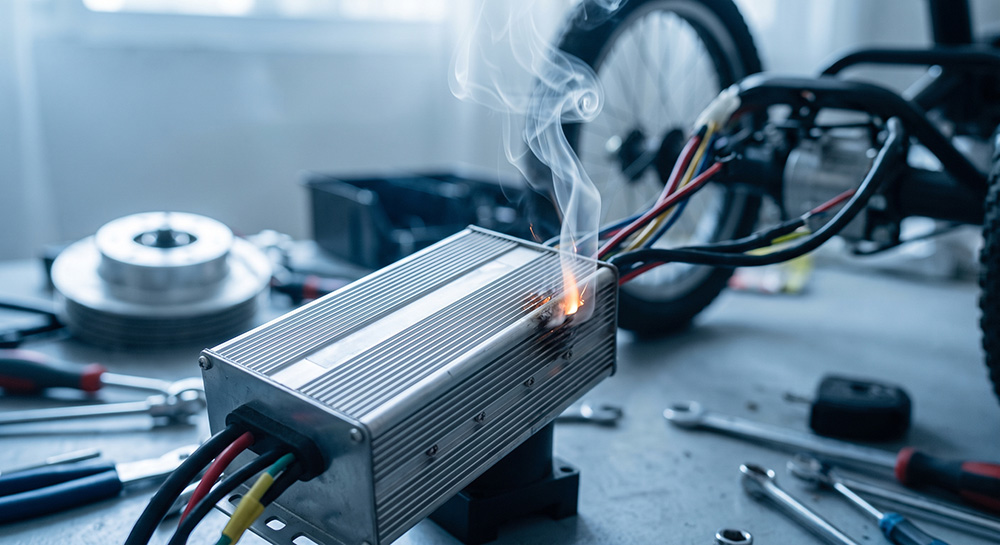
Instant Controller Breakdown: Controllers have strict voltage tolerance limits for internal capacitors and power tubes (MOSFETs/IGBTs). For instance, a 48V controller's internal capacitors typically max out around 63V. Connecting a fully charged 60V+ battery can instantly pierce these components, causing the controller to smoke, burn out, or even trigger highly dangerous "runaway" accidents due to chip malfunction.
Motor Insulation Meltdown: High voltage forces the motor into a sustained state of overload, excessive RPM, and extreme heat. When this heat exceeds cooling limits, the insulation material on the internal copper coils melts, leading to a phase short circuit. Under the heavy-duty conditions of commercial freight, this damage is irreversible and permanently scraps the motor.
2. The "Chronic Poison" of Undervoltage
Using a low-voltage battery in a high-voltage system (e.g., a 48V battery in a 60V vehicle) is equally damaging, though slightly more insidious:
Abnormal Current & Overheating: Basic physics dictates that Power = Voltage × Current. Assuming the vehicle's payload and required motor power remain constant, a drop in supply voltage forces the system to draw significantly higher current. This continuous, abnormal current causes the main wiring harness and Hall sensor connectors to heat up violently, accelerating wiring aging and risking spontaneous combustion from short circuits.
Premature Battery Degradation: A controller's undervoltage protection parameter is a fixed baseline. Plugging in a lower-voltage battery will either cause the Battery Management System (BMS) and controller to trigger constant power-off protections, or force the battery into a state of extreme, deep-discharge depletion. This electrical abuse causes the battery's cycle life to plummet, entirely stripping it of its commercial value.
3. The Commercial Perspective (For Fleets and Distributors)
As a professional deeply engaged in the export of universal motorcycle spare parts and commercial electric vehicles, I always emphasize one core principle to my partners: For commercial transport, vehicle availability and stability are the lifelines of the business.
In regions where the spare parts supply chain is still developing, "cobbling together" non-standard replacements might seem like a quick fix to get a vehicle back on the road. However, the inevitable results are skyrocketing after-sales claim rates, exorbitant downtime repair costs, and incalculable safety hazards. A cargo vehicle is a precisely calibrated closed-loop ecosystem—the controller, motor, and battery must be strictly matched.
Professional equipment requires professional maintenance standards. Using matching, original-spec replacement parts and refusing to alter core electrical parameters is the only sustainable path to ensuring efficient fleet operations and protecting your brand's reputation in the local market.
Have you encountered any tricky maintenance issues caused by "non-standard modifications" while operating or servicing your fleets? Let’s discuss in the comments below!
 Recommended Products
 Contact us
—— Contact:Manager
—— Tel:+86 18232889888
—— Email:sales05@tricera-moto.com
—— Url:https://www.tricera-moto.com
—— Address:Changfeng Industrial Zone, Renqiu City, Hebei Province, China